
Who is often stereotypically considered difficult? Women. The various terms we use around women who stand their ground often have a negative connotation while the words that describe men basically groom them to be a leader. Leadership, while slowly changing, still has a predominantly masculine way to do it.
I remember growing up hearing that I am bossy, assertive, dramatic, and emotional while my male family members often fell under the phrase “boys will be boys”. I had very specific gender responsibilities in my family and while I was older often had very different rules about what I was and was not allowed to do because I was a girl. It was all based around the fact that I had a uterus and therefore my responsibilities are greater than family members without one.
When A Woman Has A Critical Conversation, How Is She Described?
According to the Harvard Business Review article “The Different Words We Use to Describe Male and Female Leaders” by David G. Smith, Judith E. Rosenstein, Margaret C. Nikolov, the subjective performance evaluations in the military demonstrates a fundamental issue of how women are viewed.
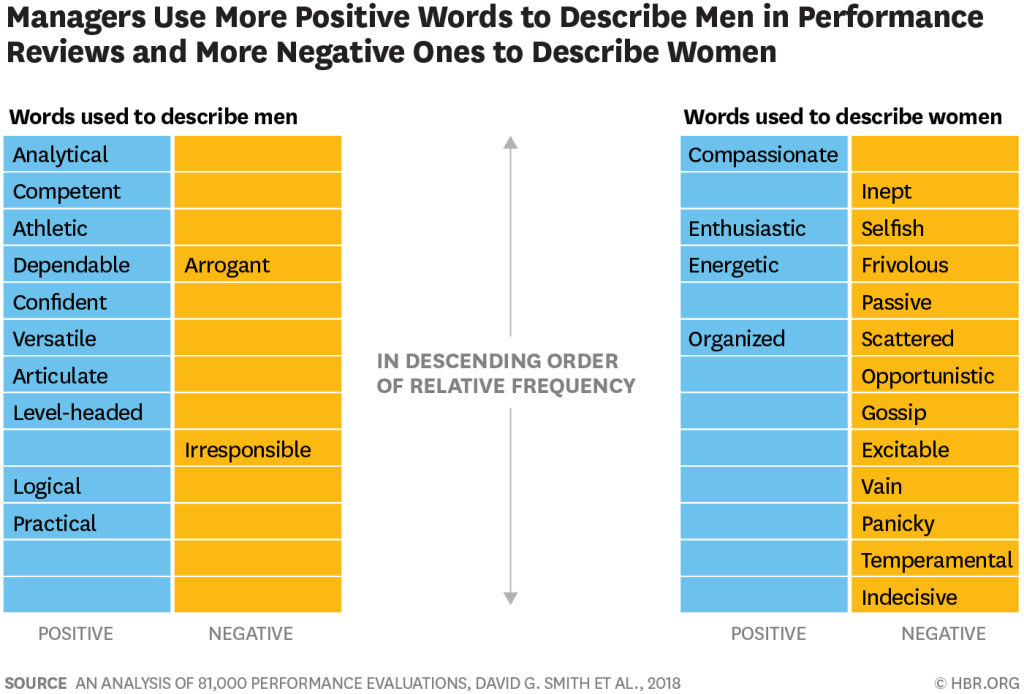
The apparent discrepancy in just the number alone is staggering. Men have 10 positive leadership qualities while women only have 4. Men only have 2 negative leadership qualities and women have 12. That’s just the most obvious aspect, examining the words used to describe each leaves me dumbfound and frustrated! This is what women leaders have to push against just to get in the door.
After listening to all the women describe their journey into having necessary conversations, I wonder how is society’s views/treatment of women and men automatically grooming men for leadership roles?
Boundary Conversations
Right now I am working on my boundary conversations because too often I say yes because I want the experience. It is very difficult for me to say no to helping others. However, over the past two years I haven’t had the boundaries I needed with work to be in my best health.
Thank you for thinking of me for this opportunity, but I respectfully decline as I have too many other priorities at the moment to dedicate my time to this and do a good job.
When asked to do something that would put me in an overwhelmed state.

This is going be something that will challenge me. I often give, give, give until I can’t anymore with my job and even my family. I feel it is a double edged sword. If I say no to something at work, I’m missing out on an opportunity to learn and show my leadership or worse they use that as way to say something about me that portrays me in a negative manner. On the other hand, my overall health and mental state cannot keep up with this go from 5:00 to 21:00 almost daily. I have to make time for me, my hobbies and things that make me happy, and my family. It’s become very apparent in the language my 5 year old used that I have prioritized work over family when she says on a “phone call” that I have so much work to do I can’t play right now. That’s sad and breaks my heart because clearly that is the language I am using. On the other end, I have put my family over me so often that I feel a little lost at times. I’ve recently started taking time for me to go for a walk and get in some exercise because that has happened WAY too little over the past six years.
Erin Sponaugle says it wonderfully in her article, ” 5 Ways Teachers Can Set Boundaries”. She talks about the martyr syndrome of being an educator especially as a woman.
One of the reasons why setting boundaries is so hard – is because teaching is a profession dominated by women. As women, we often feel it our duty to be the nurturers, to sacrifice our time and needs for the safety and security of others. I refer to this as the “martyr mentality” and the “busy badge.”
I can absolutely relate to that! I also think this stereotypes women as well. It is so ingrained in society that we take care of others and ultimately that we SHOULD be sacrificing for others because that’s what we were “created” to do.
Boundaries are how you protect your family, your health, and your soul.
Creating boundaries is the only way to sustain a teaching career for the long term. It’s you, as an intelligent, worthy individual, recognizing the necessity of a division between work and home.
…no teacher of any experience level is meant to work themselves into physical and emotional exhaustion.
Erin Sponaugle
While it is going to be difficult to change habits that began and have been in place since prior to 2006, if I am to continue to be in education, I have to be able to stand up for what I need a human being. In doing so, I will show up better for every single person in a school building who depends on me. I will be teaching my 5 year old that it is absolutely ok to say no to work and to her so that I can have time for myself. I will be a better version of myself for making these changes. It will allow me to focus on personal and professional growth in a way that helps me be the best leader.
Patterns
I am happy to learn more about how to best handle these types of conversations. I know this is an area of growth for me and I love how everyone woman talked about it being a journey. I think it is important to practice now and have a mentor give me situations and talk me through them so I can see a broader picture.

I also really struggle with asking for help. That is a difficult one for me and requires a level of trust and vulnerability I am not used to giving to others. This one is rooted deep and based on all sorts of life experiences and trauma that has proven to me more often than not, I can only depend on myself. Knowledge, of course, say otherwise, but that doesn’t change many decades of thinking and incidents that I have to overcome and rewrite how I view trust and vulnerability. I know I have work to do in this area and it begins with small steps. Also, I need to rethink how confirmation bias has played a role in my ability to trust and be vulnerable.
Address Broader Issues
One issue that I seem to have noticed over and over is that I have to keep my emotions and passionate nature at bay. I have such mixed feelings about this. On the one hand, it is important to be seen in a calm manner and approachable. On the other hand, especially since I had my daughter, the slightest heartwarming situation causes a little tear to trickle. I feel like I have to fight against the hormones I’ve been given and the person I am to fit into a masculine defined leadership. Yet, I will have no choice if that is the position I want to be in.
Esther Perel put is so eloquently in her video “Avoid Most Common Argument Patterns” that I am not allowed to “have the measuring stick of what is worthy of being upset about and what is not.” Her explanation of confirmation bias is picking up any and all evidence along the way to prove I am right what I think about the situation is the truth but also disregard any evidence that would challenge my truth or beliefs. She goes on to discuss how individual flaws are excusable but those of others are not. Leaders have to interrupt their own confirmation biases.
Tamekia MizLadi Smith’s “How To Train Employees To Have Difficult Conversations” describes how bad data perpetuates the unfortunate, underprivileged cycle. It is so important to have people to train and teach me how to ask questions when situations arise. Her goal in creating this training is to have a safe space for open dialogue with people. “People are more likely to share information when they are treated with respect.”
Goals
Reading and learning more about growth conversations from leaders in the field. I am finding any and all resources I can from Jennifer Abrams, Susan Scott, and Brené Brown. I cannot wait to delve into these books and others that will help me grow as a leader and give me tools that I need to be well prepared for any and all conversations.
I loved the advice given from the women in this course. So many mentioned Brené Brown’s “Clear is Kind”. These women spoke of their struggles to have these conversations but to do so respectfully. I’m sure wonderful male leaders do this too, but EVERY SINGLE WOMAN spoke about learning to be clear and direct but also listening, compassionate, respectful, human to human, fair, reflective, curious, solution oriented in a win-win conversation. I wonder how many male leaders ever had to stop to think about how weighty their words are and use these sorts of practices. I know that this is slowly changing but over the course of time, have male leaders been this reflective in their leadership practices?
One of the biggest challenge I know I need to grow in is not letting it consume me and overthinking every single aspect of the situation. Of course this often happens before the event, but it absolutely still continues after the event.

Having a good protocol and following up. These are my key take aways.
- Research and get as much information as possible
- Plan what I will say, write it out and rehearse it with a trusted person when possible
- Be clear and direct
- Say it authentically and with honesty
- Name the issue and impact
- Compassionately listen to their perspective and stay curious without judgement
- Validate their experiences and how the situation is going for them
- Come from a place of caring about them and their future
- Apologize if my actions have been less than supportive
- State the intended and hopeful outcome
- Follow up in email of what was discussed
- Schedule another face to face at a specific time if needed
- Remember the solution is always around what is best for students and that is what everyone wants
- Solutions that allow for growth, learning , being accountable to one another, and working together to achieve the common goal, mission, and vision of the organization
- Always act with integrity
Grace McCallum‘s article puts the steps in such easy, digestible information. I think her goal of “become comfortable with the uncomfortable” and her experience to grow from these difficult conversations truly showcase the necessity to reflect and learn from each and every conversation I have. Observing, but not dwelling, on the process and writing out the changes I could differently next time.

Practice, reflection, interruption, and change makes for great improvement, growth, learning, and doing better.

 Ms. Marcum's Mission